
Behind every attendee registered, there's a community. Behind every talk, a team. EuroPython isn't just a conference—it's a labor of grace, 100% volunteer-powered.
To the wranglers who herded sessions, the code guardians updating the conference website, the social magicians leading events, the quiet heroes debugging ticket sales systems—thank you. You’re not just volunteers; you’re the open-source spirit in human form.
In today's interview we'd like to highlight contributions of Daksh P. Jain, member of the Communications & Design Team at EuroPython 2025.
Thank you so much, Daksh!
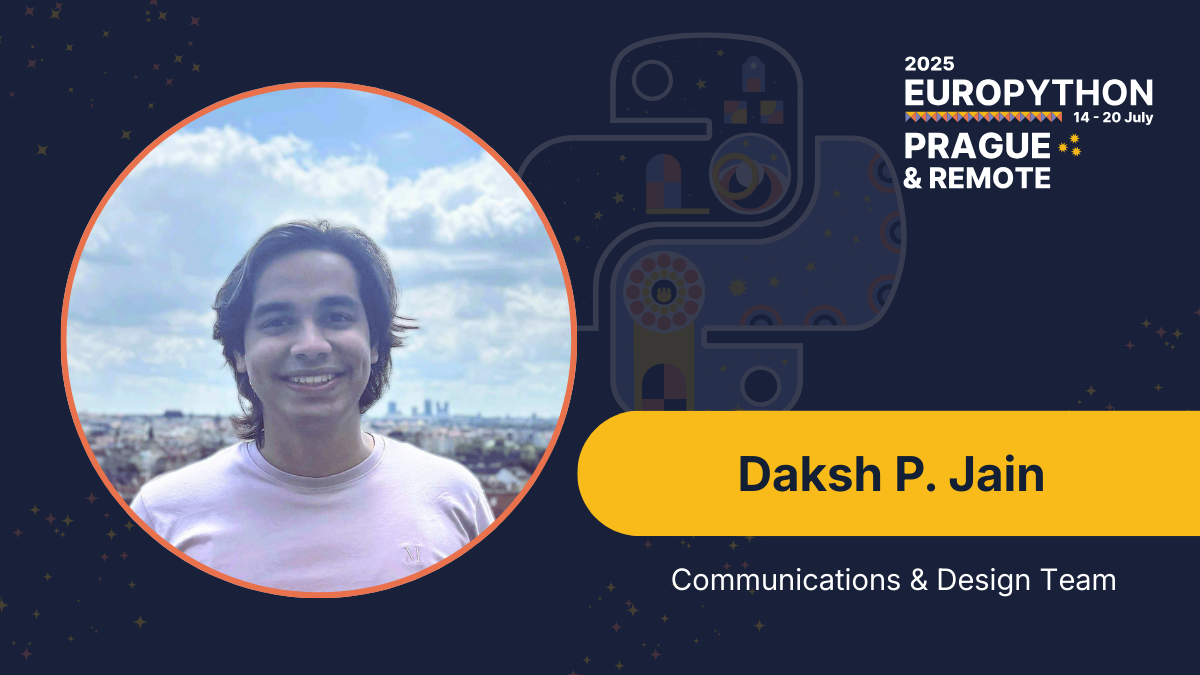
EP: Did you learn any new skills while volunteering at EuroPython? If so, which ones?
I was doing lots of designs for EuroPython - website, stickers, badge, etc., so I definitely expanded my design horizon more. Designing for thousands of attendees forced me to think more about clarity, accessibility, and consistency than I normally do (and now after the conference, I learned more about where and how I can do even better!)
On a personal level, I learned how to work with multiple teams together, and also became more confident in taking initiative, communicating my ideas clearly, and trusting my judgment.
EP: What's one thing about the programming community that made you want to give back by volunteering?
I’ve been into communities for a very very long time and I can certainly say that communities have shaped me into who I am today. I wouldn’t have learnt Python if it weren’t for a mentor I found in the community who believed in me. I wouldn’t have been organizing PyDelhi if it weren’t for the past organizers of PyDelhi who wanted me to take a step ahead. I also wouldn’t have been at EuroPython or doing a consulting/freelancing role or finding work or just being who I am without communities.
There are a lot of people who found the potential in me and wanted to see me grow, and I did (and still am!) And I want to do the same for someone else, potentially more than just a few people. And volunteering in larger communities and conferences boosts that contribution. You may not see it, but somewhere your work might be helping or shaping someone very slightly, and over the years, everything adds up to become bigger (and gives a ripple effect).
EP: Did you have any unexpected or funny experiences during the EuroPython?
There are 2 moments that are the most memorable for me:
1. We were trying to print and laminate the EuroPython 2026 ticket, to give to the person who wins the quiz. Unfortunately the paper got jammed in the printer and we were in a bit of a hurry. Initially it was just me and one person trying to fix the printer, soon enough more people joined. Eventually it took 6 software engineers and 1 YouTube video to fix the printer jam, which was as simple as removing a lid from the bottom and taking the paper out, but none of us could figure that out 😂
2. Having real conversations. I usually expect conferences to be formal where people only talk about work, and maybe do a bit of fun on the side, but not proper real conversations. Turns out I was wrong, I was able to have really beautiful (and full of depth) conversations with a few people, and those conversations till date come to mind and help me in certain situations! I’m certainly grateful for that, and this was very unexpected!
EP: What surprised you most about the volunteer experience?
I was surprised by the amount of trust and ownership given to volunteers. Even as someone new, I felt encouraged to take initiative, make decisions, and contribute beyond just “assigned tasks.” It didn’t feel like volunteering on the sidelines, it felt like being part of the core team. Also since the scale of EuroPython is massive, what surprised me was how calmly things were handled behind the scenes. Even when something went wrong, people collaborated instead of panicking. And also how well everything was planned on Google Sheets, everything from time slots to who will do what, and it was very smooth.
EP: If you could add one thing to make the volunteer experience even better, what would it be?
More ice breakers and fun activities in-person with all volunteers! I met a lot of new people and I felt that sometimes they were a little hesitant because I was unfamiliar to them, and the reverse happened with me as well, sometimes I felt a little hesitant as well. It would be great if all the volunteers and organizers could get some extra time out to just socialize and know each other better. This would make the volunteering experience a little better, and more comfortable! I’m happy to pitch in some ideas that I have seen work in the community.
EP: What would you say to someone considering volunteering at EuroPython but feeling hesitant?
My best advice would be to fight your inner thoughts a bit, and just honestly go for it! There are 2 major reasons I’d suggest anyone to try it at least once:
1. The learning and experience you get from being part of organizing something so large is really amazing. Not only do you see how things are worked out in the back end, how many people and the way people collaborate together and how the chaos is handled, it’s close to chaos engineering but in real life :P And that is a lot of fun! You might take away a lot from the chaos engineering IRL and understanding and doing people-oriented/community work in general.
2. You make really amazing friends. Personally, I made some really amazing memories with fellow volunteers while I was at EuroPython. We played games together, jammed together at the social event, attended talks and went to explore the city. If you are lucky enough, you might also find friends who you are able to share deeper thoughts and problems with, and they do it too!
Oh and did I mention everyone is very welcoming and friendly? When I joined for the first time, especially as a remote volunteer sitting in another continent who had absolutely no idea of how the conference actually works, I felt very welcome and the team helped me in understanding everything about EuroPython. There’s a lot of room for new people to pitch in ideas and own them, and get support from everyone :)
EP: What stayed with you after the conference ended?
For me, the relationships, conversations, and sense of belonging lasted far beyond the event itself, and that’s something I didn’t expect going in. I also took away a deeper appreciation for “real tech” work, people building and improving core tools and systems, not just solving product- or client-specific problems (what I do, although I know it is equally important). Coming from the Indian community ecosystem, where conferences often lean more towards services because of our largely service-based economy, it was refreshing to hear first-hand stories about things like making a better Django ORM alternative, the trade-offs involved, and the real problems faced while building foundational technology. That perspective has stayed with me and influenced how I think about my own work.
EP: Thank you for your contribution, Daksh!