Ever wonder what powers EuroPython? 🐍 No it’s not coffee—It's volunteers! From stage MCs to sponsor ambassadors, Wi-Fi wizards to vibe guardians, we’re the invisible threads weaving community magic. No title, no capes—just passion.
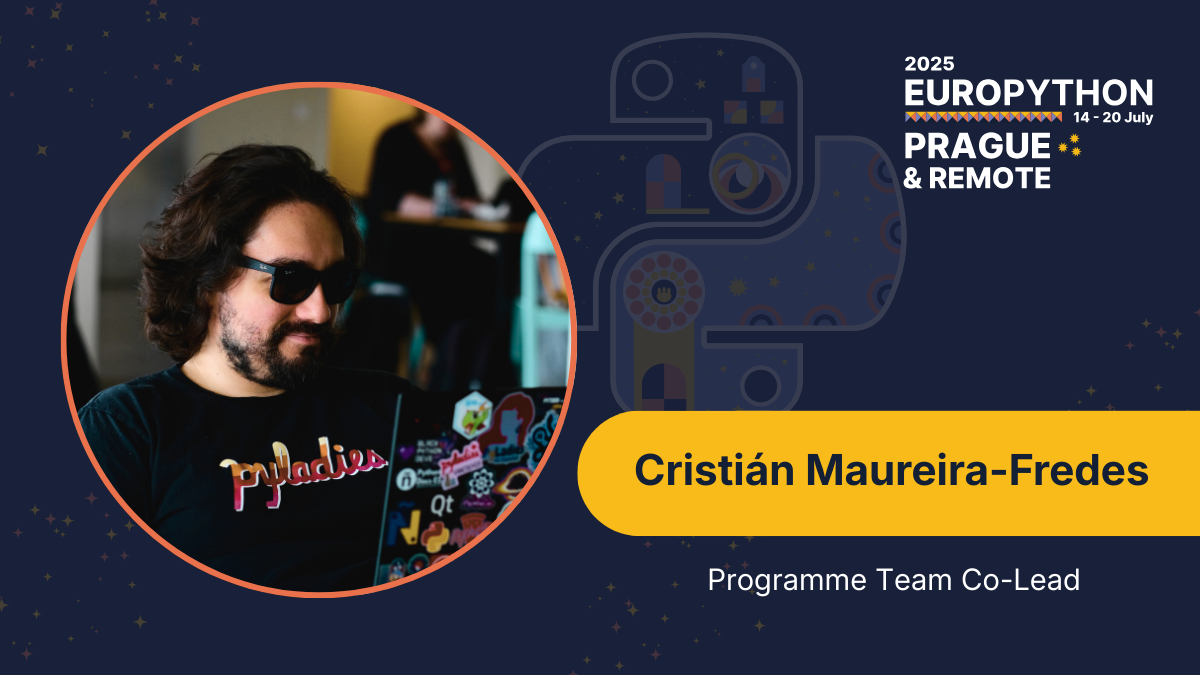
Join us in celebrating one of the humans behind the keyboard. Read our latest interview with Cristián Maureira-Fredes, co-lead of the Programme Team at EuroPython 2025.
Words are not enough to thank you, Cristián!
EP: What's one task you handled that attendees might not realize happens behind the scenes at EuroPython?
I believe many attendees from EuroPython and other conferences think that the Programme teams are usually setting up a form for people to submit proposals, then ask a few people to vote, and select the higher scores, that would be a simplistic and very incorrect description of what really happens in the Programme teams.
Besides setting up a platform for submitting proposals, there are lots of tasks that are very time-consuming, like:
- Anonymising proposals for reviewers to have a neutral approach when reviewing proposals,
- Setting up reviewers groups and communicating processes and the expected output,
- Interpretation of reviews, to avoid people mistakenly giving an incorrect negative score to proposals,
- Once scored, the submissions needs to be categorized and analyzed to create a balanced schedule which attendees expect,
There are lots of hard decisions to make. We are truthful when communicating that good proposals need to be rejected or left in the waiting list, which brings the next major invisible challenge: cancelled talks.
Every year, we have experienced lots of cancellations of confirmed talks due to many reasons, from VISA problems to no-shows. Yep, you read that right, sometimes we got confirmed speakers not showing up. Many “emergency talks” need to be quickly accepted in order to provide a schedule without many missing talks. This is the most stressful part of running a Programme team, and usually, people are not aware of it.
EP: How has volunteering at EuroPython impacted your own career or learning journey?
The human aspect of the conference is the most important part for me, I truly believe everyone volunteering to conferences wants the best for the event. Through this process, you end up knowing people better, and understand their motivations and decision-making direction. We, humans, are a complicated species, and wherever you have human interactions, you will have agreement and disagreement. Learning how these relationships are developed, and doing your best to avoid too much friction, is a very tricky but fulfilling part of this. I believe this has had a good impact on my career and learning journey, because at my paid work, I have a technical lead/manager position, where similar situations can occur.
Something else I have seen closely, but I have not benefited from so far, is the networking that you get out of volunteering at the conference. If you prove yourself to work well and are looking for a job, I think it’s an amazing opportunity for you to potentially find your next challenge. We have people from many companies around the globe, who certainly will consider you in case they have open positions, more importantly, if you have good dynamics with other volunteers, that works better for you than submitting your resume.
EP: Is there something about the programming community that made you want to give back by participating in EuroPython?
Totally, I remember that one of the motivations I had when starting contributing was wanting to improve things I believed (from my little bubble) needed improvement. Back then at EuroPython 2019 (my first one), I remember feeling very isolated and looking only at a few people that were doing their best to integrate new people into the community. Additionally, I noticed that not many talks were bringing new topics from my perspective, so I thought of maybe helping with reviews.
After speaking at EuroPython 2019, I failed to get a talk accepted in 2020, but decided to join remotely as well, and in 2021 got another talk accepted, but failed again in 2022. Then I thought about participating by volunteering so I could enjoy the conference not only by giving talks, but helping it directly. After all, organizers were doing a call for volunteers after each event, so it was just a matter of time.
Once I started volunteering, I noticed it was a challenging but gratifying experience, so I have been around since then, helping with whatever I can. It’s important to understand that even if you are in charge of a team, you are still a conference volunteer, so running around bringing items, contacting people, or taking care of other volunteers is your responsibility as well.
I enjoy being in touch with friends, having a nice time, and celebrating when the conference is over.
EP: If you could describe the volunteer experience in three words, what would they be?
I’d say for me the words are: “Motivating - Challenging - Rewarding”.
Motivating, because initially you are swamped with ideas on how to improve everything and make an even better conference.
Challenging, because you need to be prepared to solve problems, some of which are new, and it is up to you to do your best.
Rewarding, because of those moments when everything is over, and you see the smile on people’s faces, and how much they are looking forward to the next one. That is a nice reward.
EP: Did you have any unexpected or funny experiences during the EuroPython?
Leaving behind the unexpected last-minute cancellations experiences that I mentioned before, which were very unexpected, I believe that meeting people in-real-life has been very cool! You meet people in online communities all the time, people working on modules or projects that you use, or who you have seen online. Additionally, getting to know people who have been organizing EuroPython in the past or other conferences around Europe and the world has been very nice.
From the funny side, I’d say there are little things, like discovering you attended events together with other folks, but back then you didn’t know each other, or that in the past there was some interaction on Telegram, Discord, or IRC (yeah, I’m that old) and noticing “wow, so you are <nickname>!”.
EP: What keeps you coming back to volunteer year after year?
As I mentioned before, I think the human part is what motivates me the most. I know that by being there, I’m responsible for making things work well, for people to be happy, comfortable, enjoying talks, or talking in the corridor. And maybe some people will think “You know what? Next time I will be volunteering, I love this conference”, this is what brings me to EuroPython every year.
Meeting other volunteers, organizers and attendees that I haven’t met for many months, even years, is always a good excuse as well. EuroPython has become a meeting point for many people in our community, and I would like for that to never disappear.
EP: What is the key to being a good volunteer at EuroPython?
Being responsible for what you committed yourself to do is the key. We all have issues which we need to handle and leave the conference aside, but many people fail to communicate. Believe me, people will understand those situations, but it is very important to be upfront and say “Hey, I don’t have time this week/month, can someone take care of ___?”.
This is volunteering work, but volunteering still needs reliable people, otherwise things can fail. Many people feel bad not being able to do something, but as long as you don’t disappear without a trace, and people don’t need to figure out what you were working on, or if someone else should pick up your tasks, that’s a great portion of what defines “a good volunteer” in my eyes.
EP: Thank you, Cristián!